
Sustainability in solar energy now extends far beyond carbon reduction to encompass workforce diversity, equitable market access, and inclusive governance structures that determine who benefits from the clean energy transition. This expanded definition recognizes that environmental goals cannot be separated from social equity: a truly sustainable solar sector must create economic opportunity across all communities, build resilient supply chains through diverse partnerships, and ensure that clean energy access reaches underserved populations rather than reinforcing existing inequalities.
The business case is compelling. Solar companies that embed inclusive practices into their operations report stronger innovation pipelines, improved risk management, and enhanced access to capital as ESG-focused investors increasingly scrutinize social metrics alongside environmental performance. Projects designed with community engagement from inception face fewer delays, secure more favorable policy support, and achieve better long-term outcomes.
Yet the gap between aspiration and implementation remains significant across European solar markets. While 2026 has seen growing commitment to diversity targets and community solar initiatives, meaningful progress requires moving beyond voluntary pledges to systematic change in hiring practices, procurement decisions, and stakeholder engagement models.
This article examines how leading solar organizations are translating inclusive principles into concrete sustainable practices. We explore workforce strategies that tap underutilized talent pools, market approaches that expand solar access to low-income households and rural communities, and governance frameworks that give affected communities genuine influence over project development. The evidence shows that inclusivity and sustainability reinforce each other, creating competitive advantages for companies and accelerating the energy transition Europe needs.
Defining Sustainability Beyond Environmental Metrics
Sustainability in the solar sector has evolved beyond megawatt capacity and carbon savings. While environmental performance remains foundational, Europe’s energy transition now recognizes that true sustainability rests on three interdependent pillars: environmental integrity, social inclusivity, and economic accessibility. A solar installation that reduces emissions yet excludes local workers from employment opportunities, or that delivers cheap electricity to affluent suburbs while bypassing low-income neighborhoods, fails the broader test of sustainability.
This expanded framework acknowledges what practitioners have learned through implementation: environmental goals collapse without social license. Projects that bypass community consultation face delays, legal challenges, and reputational damage. Supply chains built on exploitative labor practices create vulnerabilities that undermine long-term resilience. Financing structures that favor established players lock emerging markets and underrepresented entrepreneurs out of the transition, limiting innovation and market reach.
The European Commission’s emphasis on a transition that leaves no one behind reflects this reality. Policymakers recognize that achieving 2050 carbon neutrality demands broad participation, diverse workforces bringing fresh problem-solving approaches, inclusive deployment ensuring public support, and equitable benefit distribution that maintains political will through decades of transformation.
Economic accessibility acts as the connective tissue. When solar technology remains financially out of reach for rural regions or small businesses, adoption stalls regardless of environmental benefits. Diverse supply chains reduce dependency risks and strengthen bargaining power. Inclusive procurement practices open contracts to local firms, keeping economic benefits circulating within communities rather than flowing to distant corporations.
This integrated approach transforms sustainability from a compliance checklist into a strategic framework. Companies addressing all three pillars simultaneously gain competitive advantages: stronger stakeholder relationships, enhanced innovation capacity, improved risk management, and alignment with investor expectations. Environmental metrics still matter, but they now sit within a richer understanding of what makes solar energy genuinely sustainable across European societies.
Workforce Diversity: Building a Resilient Solar Industry

Closing the Gender Gap in Solar Energy
Women hold approximately 28% of jobs in Europe’s renewable energy sector, with representation dropping to 18% in technical and engineering roles within solar companies. This gender imbalance limits the industry’s talent pool and innovation potential at a critical growth phase.
Several European solar businesses are implementing targeted recruitment programs partnering with universities to encourage women into STEM pathways. Mentorship initiatives connect early-career women with senior leaders, creating visibility for advancement opportunities. Flexible work arrangements and transparent promotion criteria help retain female talent who might otherwise leave technical roles.
Leadership development programs specifically designed for women in renewable energy are gaining traction. Spain’s Solar Women Network and Germany’s Women in Energy associations provide networking, skills training, and advocacy that increase women’s participation in policy discussions and executive positions.
Policy interventions matter too. EU-funded training programs offer renewable energy certifications to women transitioning from other sectors. Some member states now require gender diversity reporting from solar companies bidding on public contracts, creating accountability.
Companies with gender-balanced teams demonstrate measurably better problem-solving and stakeholder communication. Solar businesses that prioritize women’s participation access broader talent, connect with diverse customer segments, and build organizational resilience that strengthens long-term sustainability outcomes.
Regional and Socioeconomic Inclusion
The solar energy transition risks concentrating benefits in already-prosperous regions unless active measures redirect opportunities to economically disadvantaged areas. Across Europe, targeted training programs now establish solar career pathways in communities facing high unemployment or industrial decline. Poland’s coal regions, for instance, host reskilling initiatives that convert former mining workers into solar installers and maintenance technicians, providing stable employment while advancing decarbonization.
Community-based solar cooperatives in Spain’s rural provinces demonstrate another approach: local residents receive technical training to operate distributed solar installations, keeping jobs and energy revenues within their communities rather than sending them to distant corporate headquarters. These models prove particularly effective in southern Italy and eastern European regions where traditional manufacturing has contracted.
Apprenticeship programs that waive expensive upfront training costs remove financial barriers for low-income candidates. Germany’s vocational dual-education system, expanded to include solar technologies, allows students from disadvantaged backgrounds to earn while learning. Mobile training centres bring photovoltaic education directly to remote areas lacking permanent technical schools.
When solar businesses recruit from diverse socioeconomic backgrounds, they gain employees with problem-solving perspectives shaped by resource constraints, exactly the mindset needed for developing affordable, scalable renewable solutions across varied economic contexts throughout Europe.
Accessible Solar Solutions for All Communities
Ensuring solar technology benefits all communities requires deliberate design choices that address real barriers. In 2026, European solar providers increasingly recognize that standard residential installations, requiring upfront capital, homeownership, and suitable roofs, exclude significant portions of the population. This realization is driving practical solutions.
Community solar programs allow multiple households to share a single installation, removing the need for individual rooftops or property ownership. Participants subscribe to a portion of a centrally-located solar array and receive credits on their electricity bills proportional to their share. Germany’s tenant electricity models and collective self-consumption frameworks in France demonstrate how shared systems bring solar benefits to apartment dwellers and renters who previously had no access. These structures directly counter the concentration of solar advantages among property-owning households.
Financing represents another critical access point. Traditional bank loans often exclude applicants without strong credit histories or stable income documentation. Innovative mechanisms are filling this gap: pay-as-you-save programs where bill savings cover installation costs, on-bill financing through utility partnerships, and revolving loan funds managed by local authorities with flexible qualification criteria. The Netherlands’ energy poverty action plans include grant-and-loan combinations that reduce upfront barriers for vulnerable households. Such approaches align financial communities with social outcomes, creating pathways where conventional lending falls short.
Product design itself matters. Modular systems that can scale incrementally, plug-and-play solutions requiring minimal technical expertise, and equipment sized for smaller budgets make solar adoption more achievable. Renewable energy innovations increasingly prioritize accessibility alongside efficiency gains.
Policy frameworks either enable or obstruct these inclusive approaches. Feed-in tariff structures that recognize community installations, streamlined permitting for shared systems, and targeted subsidies for low-income adopters shape what becomes financially viable. Spain’s social bonus for electricity extends to community solar participants, directly linking energy affordability programs with renewable deployment.
Rural areas face distinct challenges: lower population density makes individual installations proportionally more expensive, and limited installer networks reduce competition. Mobile installation teams, cooperative purchasing models, and regional deployment targets help distribute solar infrastructure beyond urban centers where market forces naturally concentrate investment.
Inclusive Stakeholder Engagement and Decision-Making
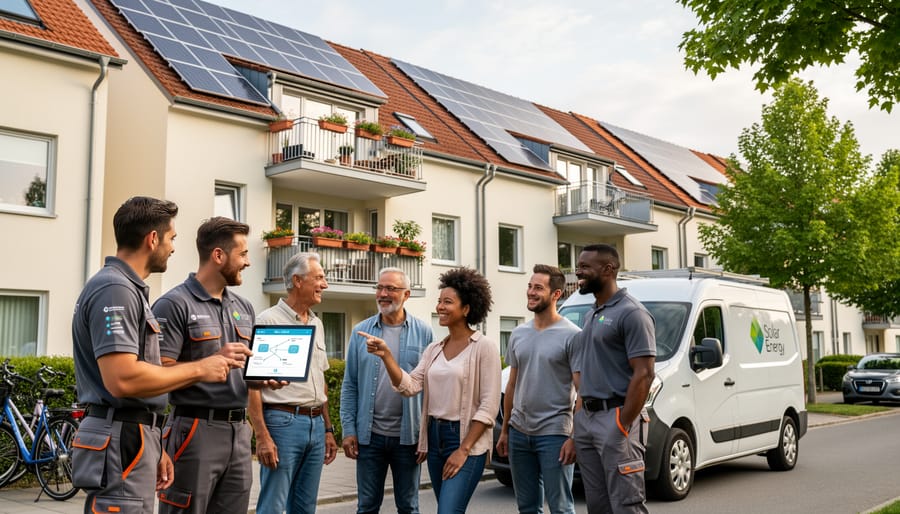
Solar projects succeed or fail based on community acceptance. Traditional top-down planning approaches often miss critical local knowledge, cultural considerations, and practical barriers that can derail even well-intentioned initiatives. Incorporating diverse stakeholders from the outset creates more resilient, contextually appropriate solutions.
European solar developers increasingly use participatory design processes that bring local governments, small business owners, farmers, indigenous groups, and residents into planning conversations before finalizing project specifications. This collaborative approach identifies potential conflicts early, uncovers site-specific opportunities, and builds genuine community ownership. A 2026 study across twelve EU member states found that solar installations developed through inclusive stakeholder engagement experienced 40% fewer project delays and achieved commercial operation 6 months faster on average than comparable projects using conventional approval processes.
Meaningful participation requires more than token consultation. Effective frameworks provide stakeholders with accessible information in multiple languages, hold meetings at times and locations that accommodate different work schedules, and offer technical support so non-specialists can contribute substantively. Some regions have established solar citizen advisory boards with rotating membership that includes representation from elderly populations, disability advocates, agricultural cooperatives, and minority communities.
The benefits extend beyond smoother project implementation. Diverse stakeholder input improves technical outcomes by surfacing local environmental conditions, identifying dual-use opportunities like agrivoltaics, and highlighting infrastructure constraints that desktop analysis might miss. Indigenous communities bring traditional ecological knowledge that can inform site selection and biodiversity protection strategies. Small business associations contribute insights on commercial demand patterns that shape optimal microgrid configurations.
Policy frameworks work best when developed through similarly inclusive processes. Countries that convened diverse stakeholder groups during feed-in tariff design produced more equitable subsidy structures and identified barriers to participation that homogeneous policy teams overlooked. This collaborative approach transforms stakeholders from potential opponents into active partners invested in the solar transition’s success.
Market Advantages of Inclusive Sustainable Practices

Companies that embed inclusive practices into their solar operations unlock measurable competitive advantages that extend far beyond ethical compliance. Diverse teams generate more innovative solutions because they bring varied problem-solving approaches and lived experiences to technical challenges. A 2026 analysis of European solar businesses found that companies with gender-balanced leadership teams filed 23% more patents than industry peers, while firms actively recruiting from underrepresented communities reported 19% faster product iteration cycles. This innovation edge translates directly into market positioning as these businesses can bridge the gap between technology development and diverse customer needs more effectively than competitors with homogeneous teams.
The financial case for inclusive sustainability has strengthened considerably. ESG-focused investment funds now control over €4.2 trillion in European capital markets, and 2026 data shows 68% of these funds explicitly screen for workforce diversity and community engagement metrics alongside environmental performance. Solar companies demonstrating measurable social sustainability attract lower cost of capital, averaging 0.7 percentage points better loan rates than sector benchmarks. Insurance providers increasingly offer premium reductions to businesses with documented inclusive supply chains, recognizing that diverse vendor networks reduce concentration risk and supply disruption exposure.
| Business Outcome | Inclusive Approach | Traditional Approach |
|---|---|---|
| Innovation Rate (Patents/Year) | 12.3 average | 10.0 average |
| Market Growth (Annual %) | 17.4% | 12.1% |
| ESG Investment Access | Full eligibility | Limited or excluded |
| Regulatory Compliance Score | 94/100 | 78/100 |
Market reach expands when solar businesses reflect the communities they serve. Companies with inclusive customer engagement strategies access market segments traditional competitors overlook, capturing revenue from community solar programs, tailored financing products for lower-income households, and public procurement contracts that increasingly mandate diversity criteria. This isn’t theoretical positioning; it represents real growth in addressable market size and win rates on competitive bids where social sustainability criteria determine contract awards.
Common Questions About Inclusive Sustainable Practices
Solar industry leaders frequently ask how to translate inclusive sustainable practices from principle into action. Understanding how they work in practical terms helps organizations move forward with confidence.
How do we measure inclusivity in solar projects?
Track workforce diversity metrics, community participation rates in project planning, accessibility of financing programs across income levels, and geographic distribution of installations. Many organizations now include these social indicators alongside traditional environmental KPIs in their sustainability reports.
What return on investment can we expect from inclusive practices?
Companies implementing inclusive hiring and community engagement report expanded market reach, reduced project opposition, stronger innovation pipelines, and improved ESG ratings that attract investment. While social returns compound over time, many organizations see measurable market advantages within 18-24 months.
How do inclusivity and environmental sustainability goals complement each other?
Inclusive practices strengthen environmental outcomes by bringing diverse perspectives to technical challenges, ensuring broader adoption of clean energy solutions, and building the resilient workforce needed for long-term decarbonization. Social equity and environmental progress are interdependent, not competing priorities.
What are practical first steps for organizations new to this approach?
Start with a baseline assessment of current workforce composition and community engagement practices, then identify one specific area for improvement such as recruitment partnerships with underrepresented groups or accessible financing pilot programs. Focus on meaningful action in a defined scope rather than attempting comprehensive transformation immediately.
The most effective organizations treat these questions not as obstacles but as opportunities to refine their approach. Resistance to inclusive practices typically stems from misconceptions about costs or complexity rather than fundamental conflicts with business objectives. When leadership frames inclusivity as essential infrastructure for sustainable growth, stakeholder buy-in follows more readily.
Europe’s journey toward sustainable solar energy cannot succeed through technological advancement alone. The evidence is clear: genuine sustainability requires inclusive practices woven into every aspect of the solar sector, from workforce development to market access, from policy design to project implementation. Environmental goals and social equity are not competing priorities but reinforcing foundations of long-term success.
The solar businesses, policymakers, and investors who recognize this integration position themselves at the forefront of Europe’s energy transition. Companies embracing diverse teams demonstrate stronger innovation capacity. Projects designed with community input achieve better acceptance and outcomes. Financing models that reach all income levels unlock untapped markets while delivering energy justice.
As Europe accelerates toward its 2050 carbon neutrality targets, the solar sector’s resilience will depend on how broadly it distributes opportunities and benefits. Inclusive practices expand the talent pool, reduce implementation risks, and build public support essential for scaling deployment. They transform solar energy from a technological solution into a social movement with staying power.
The path forward is collaborative. Stakeholders across the solar value chain can drive this integrated approach, creating accessible career pathways, designing equitable products, and engaging diverse voices in decision-making. This isn’t corporate responsibility separate from business strategy; it’s the strategic foundation for a sustainable European solar industry that serves everyone.