
Financial communities represent the ecosystem of investors, lenders, development banks, and financial institutions that channel capital into solar energy projects, and engaging them effectively requires solar professionals to speak their language of risk-adjusted returns while demonstrating how photovoltaic investments deliver both competitive financial performance and measurable climate impact. These communities have matured significantly since 2020, evolving from cautious observers to active participants who now view solar as a mainstream asset class rather than a speculative bet.
The transformation reflects concrete market signals. Institutional investors managing trillions in assets have redirected portfolios toward renewable energy infrastructure, driven by fiduciary duties that increasingly incorporate climate risk, regulatory frameworks favoring clean energy, and improving project economics that make solar competitive without subsidies in most European markets. Development finance institutions and commercial banks have developed specialized solar lending desks, standardized due diligence processes, and green bond instruments tailored specifically for photovoltaic deployments.
For solar professionals seeking capital in 2026, success depends on understanding what financial communities prioritize: proven technology with reliable performance data, creditworthy offtake agreements, transparent project structures, and development teams with execution track records. The relationship works both ways. Financial institutions bring more than money; they offer market intelligence, risk management expertise, and the credibility that attracts additional partners.
Building productive partnerships requires preparation. Solar developers must present projects with the financial rigor that lenders expect, while investors need education on technical aspects that determine long-term returns.
Understanding Financial Communities in the Solar Energy Context
Financial communities in the solar energy sector encompass the diverse network of capital providers, investment intermediaries, and financing specialists who collectively determine where and how money flows into renewable energy projects. Unlike traditional energy finance that long favored fossil fuel infrastructure, these communities have evolved to understand and support solar technologies’ unique characteristics, risk profiles, and return potential.
At their core, financial communities represent the ecosystem of organizations and individuals who allocate capital, structure deals, and manage investment risks across solar deployment. Their composition has grown increasingly sophisticated as solar has matured from niche technology to mainstream energy source.
- Institutional Investors
- Pension funds, insurance companies, and sovereign wealth funds that deploy large-scale capital into established solar assets, seeking stable long-term returns with lower risk profiles.
- Development Banks
- Public financial institutions like the European Investment Bank that provide concessional finance and risk mitigation tools to catalyze solar projects in emerging markets or innovative technology segments.
- Green Finance Networks
- Specialized investment platforms and banking consortia focused exclusively on environmental and climate-positive projects, offering tailored products for renewable energy developers.
- Venture Capital Firms
- Early-stage investors targeting innovative solar technologies, business models, and software solutions, accepting higher risk for potentially transformative returns.
- Community Investment Platforms
- Crowdfunding and cooperative financing models that enable citizens and local investors to participate directly in solar projects, democratizing access to renewable energy investment.
These financial communities don’t operate in isolation. They interact dynamically, with development banks often providing first-loss capital that attracts institutional investors, while venture capital firms fund innovations that eventually become bankable projects for mainstream finance. Their collective influence extends beyond capital provision, they shape technical standards, drive transparency requirements, and signal market confidence through investment decisions. When financial communities embrace specific solar technologies or markets, they create momentum that attracts additional capital, reduces financing costs, and accelerates deployment timelines across Europe’s energy transition.
The Investment Landscape for Solar Energy in 2026
Shifting Risk Perceptions
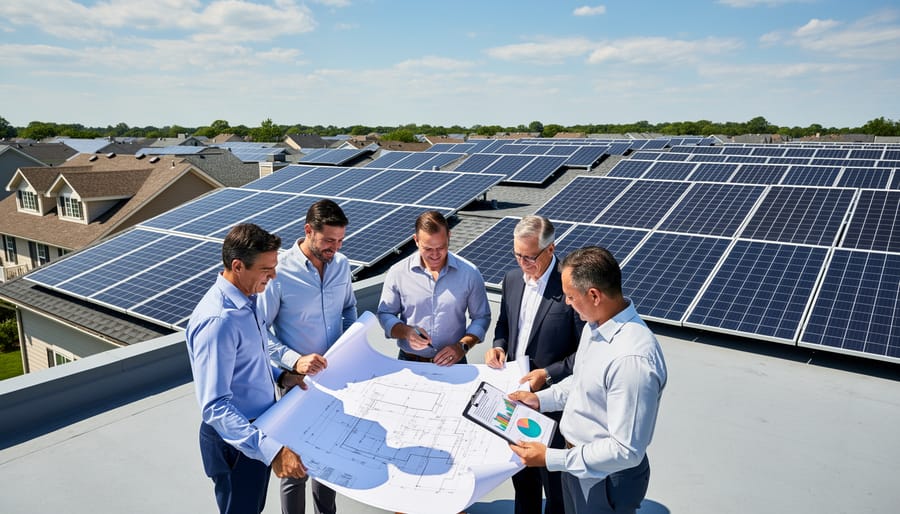
Over the past decade, the financial sector’s assessment of solar energy investments has undergone a remarkable transformation. Where solar projects were once categorized alongside speculative ventures, they now occupy portfolios as infrastructure assets with predictable cash flows comparable to utilities.
This shift stems from accumulated performance data demonstrating that operational solar installations consistently deliver anticipated returns. Financial communities have observed default rates on solar project debt declining to levels rivaling conventional power generation, while revenue volatility has proven minimal thanks to long-term power purchase agreements and feed-in tariffs. The technology itself has matured beyond early-stage uncertainty, panel degradation rates are well-documented, maintenance costs are predictable, and performance modeling has become highly accurate.
Institutional investors now recognize solar’s correlation with broader market movements as low, making it an attractive diversification tool. Development banks and pension funds, previously cautious about renewable energy exposure, have reclassified solar from alternative investments into core infrastructure holdings. This reclassification has profound implications: lower required returns, longer investment horizons, and substantially larger capital pools willing to finance projects. What financial communities once viewed as pioneering risk is now understood as an established asset class with quantifiable, manageable characteristics.
New Financial Instruments Enabling Growth
Financial communities have developed an array of sophisticated instruments specifically designed to channel capital into solar energy projects at scale. Green bonds have emerged as a cornerstone mechanism, allowing institutional investors to support climate-aligned projects while meeting sustainability mandates. These fixed-income securities earmark proceeds exclusively for environmental initiatives, and green bonds finance climate goals across Europe by directing billions toward renewable infrastructure. Solar developers increasingly tap this market for utility-scale installations and distributed generation portfolios.
Sustainability-linked loans represent another innovation, tying interest rates to predefined environmental performance targets. Solar companies achieving ambitious deployment milestones or carbon reduction benchmarks receive favorable borrowing costs, creating direct financial incentives for accelerated growth. Blended finance structures combine public development funds with private capital to de-risk projects in emerging markets or support solar financing-ready innovations that require longer-term horizons. These mechanisms leverage catalytic public funding to unlock significantly larger private investment flows.
Beyond these core instruments, financial communities are deploying solar-specific revenue-based financing, securitization of residential lease portfolios, and project aggregation vehicles that bundle smaller installations into investable asset classes. Each mechanism addresses particular friction points, whether reducing upfront capital requirements, improving liquidity, or matching investor risk appetite with project characteristics. The proliferation of these tools reflects both growing market sophistication and recognition that standardized approaches alone cannot meet solar energy’s diverse financing needs across different scales and markets.
Building Effective Collaboration with Financial Communities

Speaking the Language of Finance
Translating solar project specifications into investor-ready communications requires understanding which technical attributes directly influence returns. Start by converting capacity metrics (kW, MW) into revenue projections based on local power purchase agreement rates and grid tariffs, then connect these to internal rate of return and payback period calculations that financial communities prioritize. When discussing panel efficiency or degradation rates, frame them as capacity factor impacts and revenue predictability over twenty-year horizons, investors care less about the technology itself than about consistent cash flow generation.
Present operational metrics through financial risk lenses. Equipment warranties become balance sheet protection; system monitoring capabilities translate to operational expense optimization; module durability ratings indicate maintenance cost predictability. Financial communities evaluate how innovations work to reduce levelized cost of energy, so demonstrate cost per watt improvements and efficiency gains as margin expansion opportunities rather than purely technical achievements.
Replace technical jargon with financial analogues: “bankable yield assessments” instead of irradiance studies, “asset performance ratios” rather than PR percentages, and “downside protection” when explaining insurance structures. Prepare materials that speak to investment committees, executive summaries featuring equity multiples, debt service coverage ratios, and comparable transaction valuations, while keeping technical documentation available for due diligence teams who will verify your claims.
Demonstrating Bankability and Creditworthiness
Solar projects become bankable when they present complete, verifiable information that addresses investors’ core concerns: revenue predictability, asset quality, and risk mitigation. Financial communities assess creditworthiness through standardized frameworks, so understanding their evaluation criteria is essential.
Start with robust financial modeling that demonstrates conservative revenue projections backed by power purchase agreements or feed-in tariff structures. Include sensitivity analyses showing how the project performs under various scenarios, reduced irradiation, equipment degradation, or policy changes. Investors value transparency about downside cases more than optimistic forecasts.
Technical due diligence documentation must be comprehensive: third-party engineering reports, equipment warranties from tier-one manufacturers, proven operations and maintenance contracts, and insurance coverage details. These elements transform a solar installation from a technology risk into a predictable cash-flow generator.
Establish a track record through smaller projects before seeking large-scale financing. Financial communities favor developers with demonstrated execution capability, on-time delivery history, and operational performance data from existing assets. Even new entrants can build credibility by partnering with experienced engineering, procurement, and construction firms or securing completion guarantees from established entities.
Present clear organizational structures with defined governance, experienced management teams, and appropriate debt-service coverage ratios that meet or exceed typical 1.3x thresholds for project finance.
Creating Multi-Stakeholder Platforms
Multi-stakeholder platforms transform fragmented conversations into coordinated action. Forums like the European Solar Initiative and national roundtables create neutral ground where solar businesses present pipeline data, financial institutions share investment criteria, and policymakers clarify regulatory roadmaps. These platforms generate tangible outcomes: standardized documentation that reduces due diligence costs, pilot programmes testing innovative financing structures, and advocacy agendas supported by united industry-finance voices.
Working groups focused on specific challenges, grid connection financing, residential solar scaling, or behind-the-meter project assessment, develop practical tools that individual organizations cannot create alone. Regular convenings build trust and shared understanding, replacing sporadic meetings with ongoing dialogue. When implemented effectively, these platforms accelerate deal flow by aligning stakeholder priorities before projects reach negotiation tables, reducing transaction friction and creating replicable investment frameworks that benefit the entire solar sector.
Addressing Barriers to Financial Community Engagement
Regulatory and Policy Uncertainty
Policy frameworks that shift with political cycles create substantial hesitation among financial communities considering solar investments. When subsidy schemes, grid connection rules, or permitting timelines change unpredictably, investors struggle to model long-term returns with confidence. A renewable energy fund manager in Germany noted that her institution delayed committing €200 million to distributed solar projects solely because three consecutive governments altered feed-in tariff structures within five years.
Financial communities consistently cite regulatory stability as more valuable than generous incentives. Even modest but reliable policy support attracts capital more effectively than ambitious programs that face political reversal risk. This explains why markets with established, cross-party renewable energy commitments see lower cost of capital for solar projects.
Advocacy by industry associations has proven effective in establishing policy certainty. When solar sector organizations present unified positions backed by economic data, they give policymakers the evidence needed to defend stable frameworks against political pressure. Financial communities themselves increasingly participate in these advocacy efforts, recognizing that their engagement strengthens the case for predictable regulation that protects their portfolio values while advancing climate goals.
Information Asymmetries
Investors in solar projects demand reliable data to assess performance, predict returns, and benchmark against other opportunities. Yet many financial communities encounter incomplete information about actual solar installation performance, operational costs over time, and real-world degradation rates. This data gap stems partly from proprietary business practices and partly from inconsistent measurement standards across the European market. When investors cannot access transparent, standardized metrics about how solar assets perform under different conditions, they price in higher risk premiums or avoid deals altogether. Companies that publish verified production data, maintenance histories, and detailed financial models stand out. Industry associations can help by establishing common reporting frameworks that allow financial communities to compare projects on equal terms. Better transparency around renewable tech for investment also enables investors to spot emerging technologies with genuine commercial potential versus unproven concepts. Closing information gaps transforms hesitant capital into committed funding.
The Role of Member-Led Organizations in Facilitating Finance Collaboration
Industry associations and member-led organizations function as essential bridges between solar energy businesses and financial communities, translating technical capabilities into investment-ready propositions. These organizations aggregate market intelligence, establish industry benchmarks, and create standardized frameworks that reduce information asymmetries, making it easier for financial communities to evaluate solar opportunities with confidence.
One critical function is advocacy at the policy level. Member-led organizations work with European regulators and national governments to create stable, transparent policy environments that financial communities require for long-term capital deployment. By representing collective industry interests, these bodies carry more weight than individual companies in shaping regulations around grid connection, feed-in tariffs, and renewable energy certificates.
Standardization represents another vital contribution. Organizations develop common reporting frameworks, performance metrics, and due diligence protocols that financial communities can apply consistently across projects. This standardization dramatically lowers transaction costs and accelerates investment decisions by establishing shared evaluation criteria and risk assessment methodologies.
Knowledge-sharing platforms organized by these associations facilitate direct dialogue between solar developers and potential investors. Regular conferences, working groups, and specialized forums create spaces where project developers present opportunities, financial institutions articulate their requirements, and both sides build the relationships necessary for successful partnerships. These platforms often showcase renewable energy innovations that represent emerging investment opportunities.
Member-led organizations also provide market data, trend analysis, and feasibility studies that financial communities use for strategic planning. By pooling resources to commission research that individual members couldn’t fund independently, these associations generate the comprehensive market intelligence that institutional investors need to justify solar sector allocations to their stakeholders.
Future Opportunities: Deepening Financial Community Partnerships
The solar energy financing landscape is poised for significant transformation as financial communities recognize the sector’s maturation and its central role in Europe’s energy transition. Several emerging opportunities promise to deepen these partnerships and unlock capital at unprecedented scale.
Securitization of distributed solar portfolios represents one of the most promising developments. As rooftop and community solar installations proliferate, financial communities are developing structures to bundle these smaller assets into tradeable securities. This approach transforms fragmented projects into institutional-grade investments, appealing to pension funds and insurance companies seeking stable, long-term returns. Early pilots in Germany and the Netherlands demonstrate the viability of this model for residential and commercial solar portfolios.
Technology-specific investment vehicles are gaining traction, particularly for emerging solar applications. Agrivoltaics, building-integrated photovoltaics, and floating solar systems each present distinct risk-return profiles that warrant specialized financing structures. Financial communities with domain expertise can offer tailored products that account for these technologies’ unique characteristics, accelerating their deployment beyond demonstration projects.
The integration of solar into smart energy systems financing creates new partnership frameworks. As solar generation becomes inseparable from energy storage, demand response, and grid management technologies, financial communities are developing holistic financing approaches. These structures recognize the value creation across the entire system rather than treating solar as an isolated asset. Blended finance models that combine solar generation with storage and flexibility services are particularly attractive, as they offer enhanced revenue stability and grid services value.
Perhaps most significantly, sustainability-linked corporate financing is expanding beyond project-specific loans. Major European corporations are now tying their general borrowing costs to solar deployment targets, creating direct financial incentives for accelerated adoption. This trend transforms solar investment from a standalone decision into a core element of corporate financial strategy, fundamentally reshaping how financial communities engage with the sector.
The path to Europe’s carbon neutrality by 2050 runs directly through financial communities. Without their capital, expertise, and evolving risk frameworks, solar energy’s exponential growth simply cannot materialize at the scale and speed required. This collaboration transcends transactional relationships. It represents a strategic imperative where financial communities gain access to stable, long-term returns in a maturing asset class, while solar stakeholders secure the resources needed to deploy transformative technology across the continent.
Success depends on action from all parties. Solar businesses must commit to transparency, speaking finance’s language and meeting bankability standards. Financial institutions need to continue refining their understanding of solar’s technical realities and risk profiles. Policymakers must provide the regulatory certainty that gives both sides confidence to commit. Member-led organizations facilitate these connections through standardization, advocacy, and knowledge platforms.
The evidence is clear: markets where financial communities and solar stakeholders collaborate effectively see faster deployment, lower costs, and more innovation. Europe’s renewable energy transition will be won or lost based on how well we bridge this gap. The opportunity exists now to deepen these partnerships and accelerate progress toward our shared climate goals.